

- Mon - Fri: 8.30 AM - 5:00 PM
- 26565 Agoura Rd., 200, Calabasas, CA 91302
- 818-884-8075


Intentional SEO: How an Internal SEO Audit Drove a 382% Increase in Ranking Keywords Over 9 Months

Darbi Bodie
Managing Director
2,345.28% increase in organic impressions
KEY RESULT
382% keyword growth
IMPACT
377% organic revenue growth
IMPACT
The 2-Minute Read
Legal Brand Marketing’s website was already performing well by most SEO standards. Rankings were stable. Traffic was consistent. There were no penalties or technical failures.
But branded paid search costs and lower-than-expected organic conversion efficiency suggested something else: the site was under-leveraged.
We ran an internal SEO audit to uncover hidden growth constraints.
What We Found
Minor crawl and indexing inefficiencies
Inconsistent internal linking across related content
Structured data gaps limiting contextual clarity
Hundreds of keywords ranking just outside page one
High-value keywords not intentionally mapped into content strategy
Nothing was broken. But growth was capped.
What We Did
Cleaned up structural and technical friction
Prioritized near-page keyword optimization
Strengthened schema and internal linking architecture
Published five strategically mapped posts per week
Built structured content clusters around defined keyword themes
Results After 9 Months
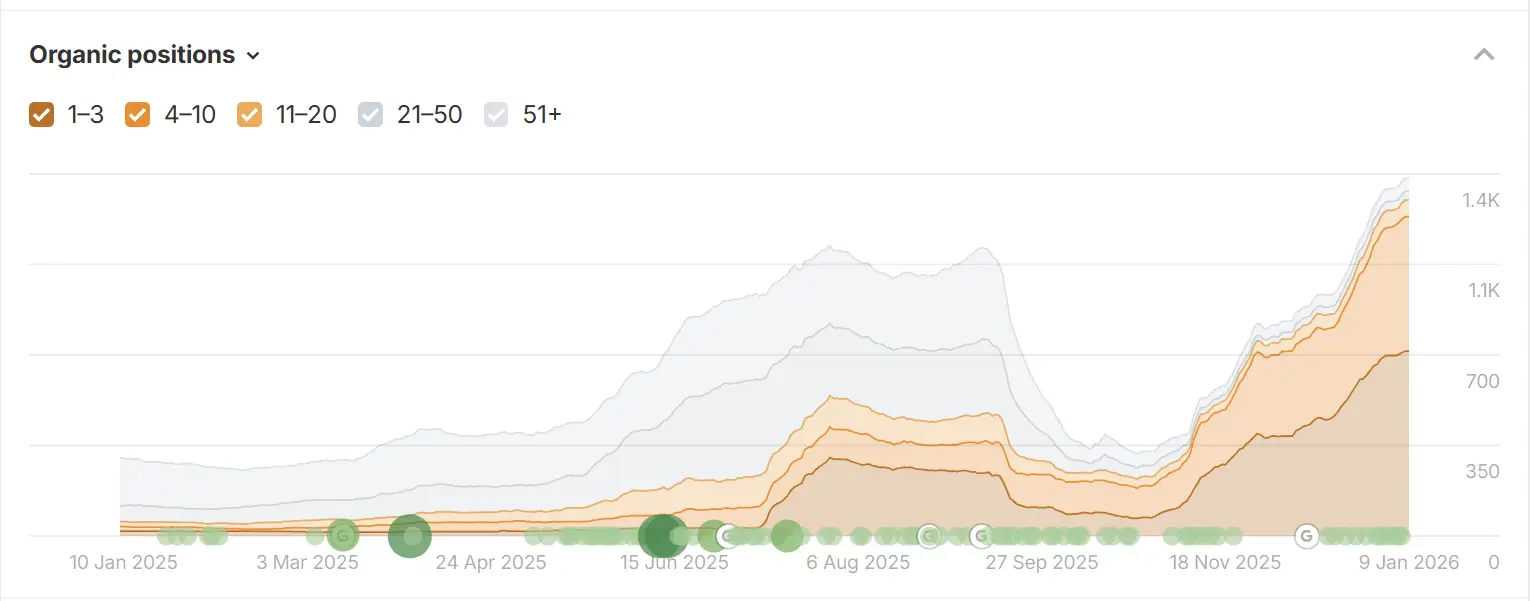
+382% growth in ranking keywords (≈219 → ≈1,056)
+2,345% increase in organic impressions
+80% growth in top 1–3 rankings
+77% year-over-year sessions
+47% increase in engaged sessions
+377% growth in organic-driven revenue
+129% increase in closed deals
Reduced reliance on paid branded search
SEO was already working.
It just wasn’t working intentionally.
Full Case Study
Full Case Study
At Legal Brand Marketing, SEO was never an afterthought.
We had a strong domain, consistent organic visibility, and years of content supporting our brand. By most benchmarks, our website was performing well.
But one signal stood out. We were spending thousands of dollars each month on branded paid search, yet conversions were underwhelming. For a company that focuses on lead quality and performance, that disconnect warranted a closer look.
This wasn’t a reaction to declining traffic or lost rankings. It was a proactive decision driven by efficiency.
Paid search was compensating for something, but we needed to understand what.
This aligns with a broader issue in digital marketing. In his analysis of sponsored ads, Neil Patel explains that businesses lose billions of dollars each year on paid advertising because traffic is often sent to sites that are not properly optimized to convert. Without strong organic foundations, paid ads end up masking deeper structural and intent misalignment issues rather than solving them. Rather than increase spend, we decided to examine the asset we already owned.
What the Audit Revealed
The audit confirmed our SEO foundation was solid, while uncovering a handful of legacy, human-error issues and several high-impact growth opportunities that were not immediately visible without a deeper review.
1. Immediate SEO Fixes
None of the issues we uncovered were catastrophic, which is precisely why they were easy to overlook.
The audit surfaced a small number of legacy issues, largely the result of routine updates and human error over time, that did not break performance but quietly limited scalability. These included:
Minor crawl and indexing inefficiencies
Inconsistent internal linking patterns across related content
Gaps in structured data that reduced contextual clarity for search engines and AI systems
Individually, these issues were subtle. Collectively, they placed a ceiling on growth that was not obvious without an intentional audit.
2. Keywords on the Cusp of the Top 10 (Near-Page Optimization)
One of the most valuable insights from the audit was how many keywords were already ranking just outside the top 10 results.
We were not starting from zero. Google already understood our relevance.
What we had not done consistently was reinforce it.
The audit revealed:
High-intent keywords ranking in positions 11–20 and 21–50
Pages with clear authority signals but limited optimization depth
This shifted our strategy away from chasing entirely new keywords and toward near-page optimization. In this case study, we use the term near-page optimization to describe the focused effort of improving keywords and pages that are already close to page one, where targeted refinements can drive meaningful gains.
3. Pages That Needed Optimization, Not Replacement
In some cases, existing pages needed refinement. In others, we needed additional content to properly support core topics and keyword themes.
The audit highlighted pages that:
Ranked without a clearly defined primary keyword
Covered topics broadly but missed specific search intent
Failed to fully reinforce core service and category pages
Addressing these gaps required a dual approach. We strengthened and clarified existing pages where appropriate, and we created new supporting content where coverage was thin or incomplete. This ensured that optimization efforts were reinforced by sufficient topical depth rather than isolated improvements.
4. Missed Keyword Opportunities
Beyond optimization, the audit also revealed relevant keywords we were not targeting at all.
Not because they lacked value, but because they had not been intentionally mapped into our content strategy. Once identified, these gaps became part of a structured roadmap, enabling more comprehensive coverage without sacrificing clarity or intent.
The Strategy Shift: Intentional, Consistent, and Scaled
With audit insights in hand, we strengthened execution across two parallel tracks.
Optimization Track
We focused on:
- Clear focus keywords per page
- Improved layout and content hierarchy
- Internal linking designed to reinforce topical authority
- Schema markup to help search engines and large language models (LLMs) properly index, understand, and cite our content
Schema was no longer treated as a technical checkbox. It became a visibility layer, especially as AI-driven discovery continues to reshape how content is surfaced.
Content Expansion Track
At the same time, we committed to a high-velocity, disciplined content strategy:
- Five new posts per week
- Sustained consistently over nine months
- Each post built around defined keywords, intent, and internal linking paths
This combination allowed us to expand keyword coverage rapidly without sacrificing structure or quality.
Results: 9 Months of Intentional SEO Execution
Rather than measuring short-term spikes, we evaluated performance across a 9-month timeline, from the initial audit through consistent optimization and content publishing.
SEO Performance Comparison: Pre-Scale vs Post-Scale
Metrics reflect performance before scaling intentional SEO versus results after sustained optimization and content execution.
| Metric | At Audit Start (Month 0) | After 9 Months | 9-Month Impact |
| Organic Search Impressions | 166,904 | 4,081,277 | +2,345.28% |
| Total Ranking Keywords | ~219 | ~1,056 | +382% |
| Top 1–3 Keyword Rankings | 334 | 603 | +80% |
| Top 4–10 Keyword Rankings | 267 | 405 | +52% |
| Keywords in Positions 11–50 | ~63 | ~627 | Pipeline expansion |
| Average Organic Position | 54.1 | 13.3 | ↑ 40+ positions |
| Total Sessions (YoY) | 32,410 | 57,420 | +77% |
| Engaged Sessions (YoY) | 10,547 | 15,458 | +47% |
| Organic Share of Sessions | ~15% | ~20% | Higher-intent mix |
| AI / LLM Citations | Minimal | Consistent growth | Expanded visibility |
What the Timeline Shows
- Early gains came from fixing structural limitations and clarifying intent
- Mid-cycle momentum was driven by near-page keyword optimization and sustained content publishing
- Later gains reflected expanded keyword coverage, improved average position, and increased eligibility for AI-driven citations
This validated a critical insight: SEO growth compounds when optimization and content velocity are aligned.
From Organic Visibility to Closed Business
While visibility and engagement gains validated the technical and content strategy, the most meaningful impact surfaced downstream.
As organic traffic quality improved, warm inbound leads attributed to organic search increasingly progressed through the funnel and converted into closed business.
Year over year, closed deals originating from organic-driven warm inbound leads increased by more than doubled demonstrating that SEO gains translated into materially higher conversion outcomes, not just additional traffic.
Importantly, these conversions were not concentrated in a single service line. Organic-driven closed business expanded across multiple legal practice areas, indicating that improvements to structure, intent alignment, and internal linking elevated overall site performance rather than isolated pages.
This confirmed that the audit did not simply improve rankings. It increased the efficiency with which existing demand was captured and converted.
FAQ
Was your SEO broken before the audit?
No. Our SEO foundation was solid. The audit identified opportunities to improve efficiency, scalability, and alignment with modern search behavior.
Why run an audit if rankings looked good?
Because rankings don’t reveal missed opportunities. Audits surface near-page keywords, structural inefficiencies, and content gaps that limit growth.
How important was new content to the results?
Very. Publishing five posts per week for nine months, paired with strong internal linking and schema, significantly expanded keyword coverage and authority.
Did optimization or new content matter more?
Neither works alone. Optimization unlocked existing potential, while consistent content publishing accelerated growth.
Why is schema markup critical now?
Schema helps search engines and AI platforms understand context, relationships, and authority, directly influencing visibility and citations.
What kind of website would be a prime candidate for results like yours?
Websites that tend to see the strongest results from an SEO audit are not necessarily underperforming sites. In our experience, the best candidates are established websites that already have authority, existing organic visibility, and consistent content history, but have not been optimized intentionally or holistically.
These sites often have:
A strong backlink profile or brand recognition
Pages ranking just outside the top results
Content that performs reasonably well but lacks clear intent alignment
Structural or internal linking inconsistencies that developed over time
Organic traffic that appears healthy but converts below expectations
In these cases, audits frequently reveal opportunities to improve conversion efficiency and unlock growth without relying on additional paid spend.
Key Takeaways
- SEO can be “working” and still be under-leveraged
- Paid search often compensates for organic inefficiencies
- Near-page keyword optimization delivers high-confidence wins
- Consistent, high-quality content velocity accelerates visibility
- Structure and schema matter as much as keywords
- AI and LLM visibility require clarity, not shortcuts
- Intentional execution over time outperforms reactive tactics
Final Thought
This was not a rescue mission. Our SEO wasn’t broken. It just wasn’t fully leveraged. The audit revealed how much demand already existed but was not being fully captured. By addressing structure, intent alignment, and scalability, organic search evolved from a visibility channel into a materially more efficient contributor to inbound lead generation and conversion.
If a site we believed was performing well held this level of untapped opportunity, many others do too. That’s why we view SEO audits as diagnostic tools. They surface leverage, not just issues.
See What Your Website Is Missing
We thought our SEO was performing well until an audit revealed clear opportunities for growth. Get a complimentary SEO audit to identify untapped keywords, structural gaps, and quick wins. Request a Complimentary SEO Audit